Showing posts with label Knot. Show all posts

Thursday, December 1, 2011

Some waders at Tinagat, Tawau end November 2011

It is the migrating season again, visits to Tinagat beach were rewarded with these waders.

I managed to record a new lifer, Grey-tailed Tattler Heteroscelis brevipes.

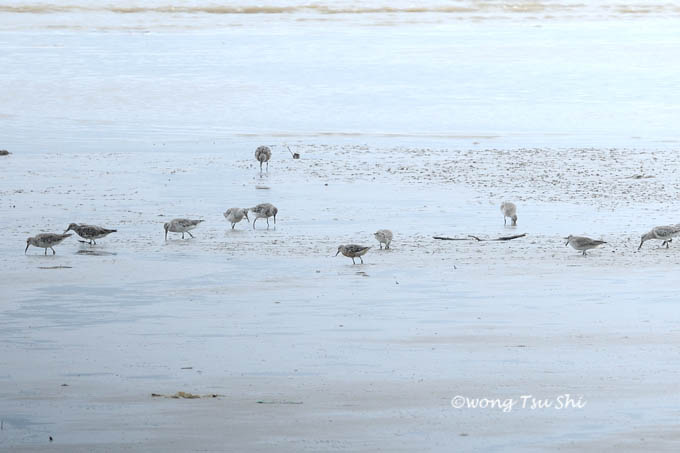
 A section of the hundreds of Great Knot, which is the commonest waders here.
 Grey-tailed Tattler, my lifer.
 Two Great Egrets, showing the range in size.
 Lesser Frigatebird, L to R, adult ♀, adult ♂ and immature.
 Eurasian Curlew
 Eurasian Curlew, showing its diagnostic white rump.
 Broad-billed Sandpiper
 Terek Sandpiper
 Bar-tailed Godwit with a Great Knot
 Pond Heron, suspected to be Chinese instead of Javan as they are only around during the northern winter, however, it is not possible to positively confirm in this eclipse plumage.
 Common Redshank
 A composite of diving Little Tern
 A Mangrove Skink Emoia atrocostata
 Common Greenshank
Far-eastern Curlew.
Happy birding.

Photodocument of Wild Birds of Borneo.

Standard References for my blog.

Monday, August 23, 2010

Red Knot

Went to Tinagat  today (22 August) to check on the waders. 

When I reached there, the tide was low and the waders were out a few hundred meters away and there was not many of them. I saw some Great Knots Calidris tenuirostris, many of them still in their breeding plumage, some presumably Red-necked Stints Calidris ruficollis, a few Terek Sandpipers Xenus cinerea,  a Grey Plover Pluvialis squatarola, a few Charadrius Plovers, two Little Terns Sterna albifrons, a few Tringa waders, a few Great Egrets Ardea alba. Nothing spectacular and none of the big curlews and Godwits were in sight.

Great Knots in various stages of moult from breeding plumage

However, on closer scanning, I saw a single bird that looked different from the group of feeding Great Knots. It has chestnut breast and is smaller than the Great Knot, it is the middle bird in the following picture.

To my delight, it is a Red Knot Calidris canutus. My lifer and my #323 photographed wild birds of Borneo.

I am lucky as it is still in partial breeding plumage, otherwise I  would have just treated it as another Great Knot, as in non-breeding plumage and size and bill differences with the Great Knot would not be that easy to differentiate from this far. It is a little smaller than the Great Knot and has shorter bill, as evident from the picture, and of course, in breeding plumage, it chestnut-red face and underparts is distinctive, we can still see the chestnut color breast here from hundreds of meters away. In contrast, a Great Knot in breeding plumage shows blackish breast and flanks made up of bold black spots, as in the first picture.

Red Knot  is a very uncommon or rare passage migrant to Borneo. Singletons and small flocks reach Borneo from Northern Asia.They have been recorded sparingly from Sabah.

The few Great Egrets are in breeding colour as in this picture, they could be actually breeding here somewhere, as they have been proven to breed in Sabah here.
 Great Egret

Happy birding.

Photodocument of Wild Birds of Borneo 

Standard References for my blog

Monday, August 9, 2010

Black-tailed Godwit and other early arrivals

Black-tailed Godwit Limosa limosa is a scarce winter visitor and passage migrant to Borneo, previous records were of mainly single bird. Sabah records were from Mumiang  in the east Coast and from Kota Belud in the west coast. No other record from Sabah has been mentioned in publications. If my memory  serves me right, I think there was a single bird in Sempulan, Kota Kinabalu one or two years ago, photographed by Sifu Jason and Sifu Karim. (Edit: My memory failed me, see comment from Sifu Jason.)

We went to Tinagat on 7th August 2010 to check on the waders and to my surprise I saw more than 10 Godwits feeding there at the tide-edge. I saw a Bar-tailed Godwit Limosa lapponica at the same place last season. (See here).

Photographs of the birds were taken without hesitation and on further checking with my field guides, they are confirmed to be Black-tailed Godwits.

It is quite easy to differentiate this from the similar looking Bar-tailed Godwit.  Here are some of the more obvious features;

- Black-tailed Godwit has straight bill, Bar-tailed has slightly upturned bill.

- Black-tailed Godwit has much longer legs, particularly longer tibia.

- Black-tailed Godwit has barred-flanks in breeding plumage, various traces of it can be seen in the fresh arrivals.

- In non breeding plumage (which we usually see them), Black-tailed Godwit has plain smooth breast and neck while Bar-tailed has streaky neck and breast.

Here are the pictures of the birds, my lifer. (#322 photographed wild birds of Borneo).


 Others birds are;
A pair of Little Tern Sterna albifrons
  
A pair of Juvenile White-bellied Sea Eagle Haliaeetus leucogaster
 
 Common Redshank Tringa totanus
 Little-ringed Plover Charadrius dubius
 Great Knot Calidris tenuirostris
Lesser Frigatebird Fregata ariel


Happy birding.

Photodocument of Wild Birds of Borneo 

Standard References for my blog

Monday, July 19, 2010

First waders of 2010 have arrived.

Went to Tinagat beach, Tawau, today to establish whether the migrant waders are here already, and true to records, which said that the first of the waders would arrive in Borneo towards the end of July, I saw a big congregation of waders on a sand bar far far away.

From observation, they comprise  mostly of Great Knot  Calidris tenuirostris, with a few sand plovers and a Pacific Golden Plover Pluvialis fulva, and may be a Broad-billed Sandpiper Limicola falcinellus and a Red-necked Stint Calidris ruficollis. Here are the photograph of the sand bar, the afternoon heat-wave had wreaked havoc to the quality of the photos.

Great Knot should look like this without the heat wave. (picture taken in 2008).
Great Knots (2008)

The following images are taken today, 18th July 2010.
The stitched image of the sand bar.

A magnification.

A further enlargement showing most of them are Great Knot.

Happy birding.